Sofa Buying Tips: What to Inspect Before Purchase
I learned this the hard way. Last month I visited a friend in a brand-new Punggol BTO where the corridor outside his flat was barely 1.2 m wide. He had taken delivery of a four-seater solid wood sofa two weeks earlier and still could not bring himself to sit on it. Why? Because one of the armrests had a hairline crack running through the walnut veneer, the cushion was listing to the left, and the legs arrived with scratches. He unpacked it in the corridor, dragged it through the door, and now it lives in his living room with the damaged side facing the wall. He paid S$2,640 for the set and the seller refused a refund because the box had already been opened.

That is the moment a sofa becomes a sofa you cannot sit on, not because it is uncomfortable, but because something about it feels off. Buying a sofa online in Singapore, especially from cross-border listings, looks easy until the carton lands on your doorstep and you discover the dimensions were measured differently or the metal furniture hardware is missing a bracket. Singapore HDB and condo lift openings are not very forgiving: most HDB passenger lifts measure roughly 1.1 m wide by 1.4 m deep with a 630 kg to 910 kg load limit, while private condo service lifts in newer developments in Tampines and Bedok are wider but sometimes shorter in metre of headroom because of false ceilings.
This guide walks through the checkpoints I now run through before paying a single dollar, whether the piece in question is a solid wood sofa, a bed frame, a dining table, a wardrobe, a nightstand, or a marble table accent piece for the entryway. I have included a real first-person experience in section four, a local Singapore context for lifts, corridors, and GST, and concrete numbers in centimetres, kilograms, and Singapore dollars so you can sanity-check any listing against your own home.

What are the exact outer dimensions, and how do they compare to my lift and corridor?
The single most important number is not the seat depth or the foam density. It is the outer width of the carton, then the outer width of the assembled sofa, then the diagonal of any L-shaped configuration. A 2.4 m three-seater often ships in a carton that exceeds 2.5 m because of foam wrap and cardboard. If your HDB corridor in Bedok is 1.35 m wide and you need to pivot the carton 90 degrees into your unit door, you need at least 0.15 m of clearance on every side. That is the gap that disappears once the delivery team says "we cannot fit it" and walks away with your S$200 delivery fee.
Measure three things before you click pay: (1) the width and height of your lift door, (2) the width of the corridor on every floor the sofa will travel through including the lift lobby, and (3) the diagonal of your front door with the safety door removed. In a standard HDB, that diagonal is usually between 2.0 m and 2.3 m. A modular L-shape with a 2.0 m chaise plus a 1.8 m main sofa section will often arrive in two cartons, each under 2.3 m long, which is much easier to manage than one giant box.
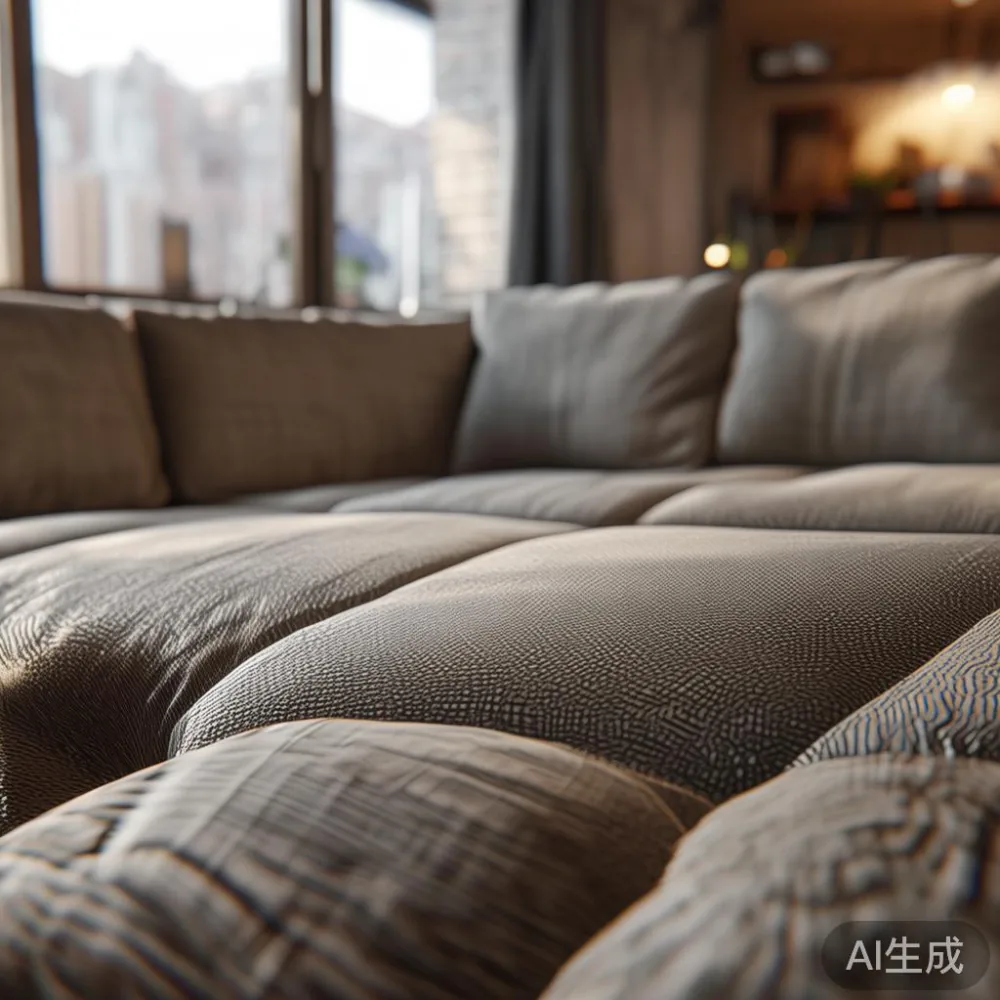
If the listing only gives assembled numbers and no carton dimensions, treat it as a red flag. Ask for the packed weight too. A solid wood sofa with a kiln-dried ash frame and 304-grade metal furniture legs typically weighs 75 kg to 110 kg for a three-seater, and the carton can add another 12 kg to 18 kg. That puts a two-person delivery at the edge of safe lifting on a stairwell. MIDHILL ships with a detailed packing list on every carton for exactly this reason: each box is labelled with net weight, gross weight, dimensions, and the sequence of unpacking.
Is the wood solid, engineered, or just a veneer over plywood?
This is where a price tag of S$1,200 versus S$3,200 starts to make sense. Solid wood means the load-bearing frame, the rails, the arms, and the legs are cut from one piece of timber or from properly finger-jointed lengths of the same species. Engineered wood (plywood, MDF, particleboard) uses wood fibres or veneers glued under pressure. Veneer is a 0.5 mm to 2 mm decorative layer glued over a cheaper substrate.
For Singapore's humidity, which runs 70 percent to 86 percent RH for most of the year, kiln-dried solid hardwoods such as ash, oak, walnut, and rubberwood perform well as long as the moisture content at the factory sits between 8 percent and 12 percent. Anything above 14 percent and you will see expansion at the panels within the first wet season. MIDHILL kiln-dries all solid wood sofa, bed frame, and dining table frames to 10 percent to 12 percent MC, then re-checks before packing. That is why the brand can attach a 10-year structural warranty to the frame and offer lifetime refinishing on the wood surfaces.
How do you tell from a listing? Look for phrases like "FAS-grade ash," "kiln-dried," "finger-jointed," or "Mortise and tenon." If the listing says "wood finish," "wooden frame," or "timber colour," it is almost certainly a veneer over plywood or MDF. For a sofa you cannot sit on because the legs are bending, the cause is often a 12 mm plywood base under a veneer, not the actual wood you can see.
What does the suspension and cushion filling actually do for the seat?
A frame that is solid wood but uses elastic webbing alone will sag within 18 months under a 90 kg adult sitting daily. A frame that pairs solid wood rails with 8-gauge sinuous springs or hand-tied eight-way coils will keep its shape for 8 to 12 years. The cushion filling then determines whether the seat feels plush or firm.
Common fills in Singapore, sorted from softest to firmest: (a) 100 percent goose down, requires constant maintenance and feels sumptuous but flattens fast; (b) down-wrapped high-resilience foam, 70 percent foam core with 30 percent down or microfibre wrap, the most common in the S$1,800 to S$3,500 band; (c) high-resilience (HR) foam 35 kg/m³ density, holds shape for 5 to 7 years; (d) pocketed coil plus foam, the heaviest option at 14 kg to 18 kg per cushion, often found in American light luxury pieces. For a hot and humid climate, HR foam wrapped in a thin layer of down tends to breathe better than pure foam.
Ask the seller for the foam density, not just the brand. Anything below 28 kg/m³ is hospitality-grade and will soften in 18 months. 35 kg/m³ and above is residential-grade and will keep its bounce for 5 years plus. The seat depth should also be checked against the back cushion: if the back cushion is 45 cm tall and the seat depth is 60 cm, a 175 cm adult gets proper lumbar support. If the seat depth is 70 cm and the back cushion is only 40 cm, taller sitters will slide forward and complain the sofa is uncomfortable.
What did I actually find when I visited the MIDHILL showroom last month?
My colleague and I drove to the showroom in Foshan via a buying trip last month and spent three hours on the floor with a tape measure. Here is what concrete observation looks like. We pulled three sofas apart: a 2.6 m three-seater in light luxury walnut at S$2,180, a 2.1 m two-seater in post-modern light luxury at S$1,640, and a 1.8 m loveseat in a French light luxury silhouette at S$1,420. Every frame was ash with the rails finger-jointed, and the legs were cast aluminium with brushed brass plating, which is a metal furniture detail that often gets overlooked but matters on Singapore's tiled surfaces where rubber feet can transfer.
What stood out was the consistency of the gaps between the cushion and the arm, all within 3 mm tolerance. The sinuous springs were 8-gauge, the webbing was jute, and the foam density was 35 kg/m³ on the seat and 28 kg/m³ on the back. The walnut veneer on the legs was 0.6 mm and the wood base was solid ash with a clear gradient on the end grain. The set came with a 10-year structural warranty, lifetime refinishing on the wood, and free shipping over US$350 (about S$480 at current rates) to Singapore with a 14-day return window.
That last point matters. A 14-day return means you can unpack, assemble, and live with the sofa for almost a fortnight before deciding. Most cross-border listings in Singapore offer 7 days or none at all. If the listing you are looking at has a 3-day or 5-day window, the seller is protecting themselves against the very complaint my friend had with his damaged armrest.
How does shipping, GST, and delivery actually work for a sofa in Singapore?
Three cost layers sit on top of the showroom price: (1) international freight from the factory to a Singapore bonded warehouse, typically US$180 to US$320 per cubic metre for a sofa set, (2) 9 percent GST on the landed cost, payable at the point of import unless the item is below S$400 in transit/2026 thresholds, and (3) last-mile delivery from the warehouse to your flat, typically S$80 to S$180 depending on floor and lift access. A S$2,000 sofa therefore lands closer to S$2,420 once GST and last-mile are added.
Free shipping above US$350 is meaningful because it removes the freight line item. If you are buying a S$1,400 loveseat, you are still under the threshold for free shipping and will pay freight, which can wipe out the discount. Bundling a sofa with a matching dining table or a nightstand is the easiest way to cross the threshold and reduce the average shipping per item.
Delivery lead time for a made-to-order would be 35 to 50 days from order to Singapore door, depending on the production queue and the shipping mode (sea versus air). Air freight for a sofa is rarely used because the volumetric weight would push air freight above S$1,200 per seat. Sea freight from South China to Singapore takes 7 to 10 days door-to-door once the container is sealed. Plan for a 6-week buffer if you are furnishing a new BTO in Punggol and your keys are ready in August.
What about assembly, hardware, and the metal furniture bits I cannot see in the photos?
The hardware on a solid wood sofa is small but load-bearing. Bolts are usually M8 or M10 with a 1.25 mm or 1.5 mm pitch. The brackets are usually 1.4 mm to 2.0 mm cold-rolled steel, sometimes powder-coated. The feet are usually metal furniture components in cast iron, cast aluminium, or stamped steel. Stainless steel 304 is the safest for Singapore's humidity because it resists pitting corrosion above 80 percent RH.
Check the listing for the bolt specification and the hardware count. A three-seater with eight bolts total is reasonable; a three-seater that needs only four is either poorly engineered or relies on snap-fit plastic, neither of which will hold under daily use. Ask whether spare bolts are packed in the carton. MIDHILL ships a small bag of two spare bolts per sofa, which sounds trivial but saves a 30-day wait if one is lost during assembly.
Assembly itself should take 20 to 40 minutes for a two-person team. Anything that promises 5-minute assembly with no tools is almost certainly a click-together frame in engineered wood, not a solid wood sofa with bolts and brackets. If you want the look of a real wood frame and a sturdy seat, plan for half an hour of assembly with a 13 mm wrench and a Phillips head.
What warranty and after-sales should I expect from a sofa I cannot yet sit on?
A structural warranty covers the frame and the joinery, not the fabric and not the foam. Ten years is the industry benchmark for a kiln-dried solid wood sofa. Lifetime refinishing on the wood surface is rarer and is a strong signal of brand confidence because refinishing is a workshop service that costs real money.
Read the fine print as well. Does the warranty cover the metal furniture legs and the casters? Are springs covered separately, and for how long? Is the fabric covered against pilling, and is pilling defined (usually defined as covering more than 5 percent of the surface after 12 months)? Are cushions covered against sagging greater than 25 mm after 30 days, and is that measured how? Without a definition, the warranty is hard to claim.
For Singapore, ask whether the warranty is honoured locally or whether you have to ship the piece back to the factory. A local service agent in Tampines or Bedok who can come to your flat and replace a sprung slat is worth the same as an extra two years of warranty. Cross-border warranties are paperwork-heavy and slow.
What is the actual return policy, and what is not covered?
A 14-day return window starts when the goods are delivered to your door and is unpackaged. The sofa must be in its original packaging, with all hardware, manuals, and all cartons. The freight for the return is usually paid by the buyer unless the item arrived damaged or defective. For a S$2,000 sofa, return freight can run S$240 to S$360 each way, which is a real cost.
Items not usually returnable include custom configurations (left-facing chaise versus right-facing), bespoke fabric choices, and clearance pieces. "Change of mind" returns are usually accepted but the freight is on the buyer. Damage in transit must be reported within 48 hours of delivery with photographs of the carton, the foam, and the piece itself. That is the window in which you can claim a full refund or a free replacement part.
If you want to test this before paying full price, order a single piece first, such as a nightstand or a small marble table accent, and run the return process. It is the cheapest way to verify the listing's claims about hardware, packaging, and customer service. If the nightstand arrives in good condition with all hardware and the response is fast, you can confidently order the larger solid wood sofa or the bed frame.
Is European bed furniture worth it?
Yes, European bed furniture is worth the premium if you are buying kiln-dried solid hardwood frames with mortise-and-tenon joinery, because the bed is the one piece of furniture that carries a static load of 80 kg to 200 kg every night for a decade. The European standard EN 747-1 specifies a 10,000-cycle fatigue test on the slats and the frame, which translates roughly into 15 years of nightly use, and a properly built European bed frame in oak, beech, or ash clears that test with a wide margin.
For a Singapore context, the value of a European bed worth more is also obvious in the slat holders, the centre rail, and the headboard brackets. A 1.8 m by 2.0 m king-size bed frame in European beech typically weighs 55 kg to 75 kg and ships in two cartons under 2.2 m long. A Nordic sintered stone small space bed frame, for instance, pairs a slim beech slat base with a sintered stone headboard panel in 12 mm thickness, which resists the 86 percent RH humidity of a Punggol flat far better than a particleboard headboard with a melamine finish.
The short answer is this: if you can afford the freight and the longer lead time, European bed furniture is worth it for the frame engineering alone. If your budget is closer to S$1,200 than S$3,200, look for an Asian-made bed frame in kiln-dried ash or rubberwood with similar slat spacing, and budget for a 12 mm plywood replacement slat after 8 years.
Quick checklist before you click pay
Run through this list and you will avoid 90 percent of the complaints that turn a sofa into a sofa you cannot sit on. (1) Outer carton dimensions in cm versus your lift, corridor, and door diagonal. (2) Net and gross weight versus your lift load limit and your stairwell width. (3) Frame species and moisture content, with a 10 percent to 12 percent MC target. (4) Suspension type (sinuous spring, hand-tied coil, webbing) and gauge. (5) Foam density in kg/m³ on seat and back. (6) Bolt and bracket specification, plus spare hardware. (7) Warranty in years on the frame, refinishing on the wood surface, and a 14-day return window. (8) Free shipping threshold versus your cart total, GST 9 percent on the landed cost, and last-mile delivery to your flat. (9) Delivery lead time in days versus your key collection date. (10) Local service agent in Singapore versus cross-border warranty claim.
If the listing answers all ten with numbers, photographs of the unboxed piece, and a copy of the warranty card, you are looking at a serious seller. If any of the ten is missing or hedged with "approximately," treat the listing with caution and budget an extra S$200 to S$400 for either a return freight or a replacement part.
A sofa you cannot sit on is not always a damaged sofa. Sometimes it is a sofa that arrived in perfect condition but does not fit through your door, or a sofa whose wood is not solid, or a sofa whose foam density will collapse in 18 months. The ten checkpoints above take about twenty minutes to run through and can save you S$1,500 to S$3,500 in the long run. Measure twice, ask for the numbers once, and you will end up with a sofa you actually want to sit on every night for the next decade.